
In the food and beverage industry, poor maintenance scheduling doesn’t just lead to breakdowns — it can result in contamination, failed audits, and costly recalls. Every missed inspection or delayed repair carries real risk, not just to operations, but to consumer safety and brand reputation.
That’s what makes plant maintenance uniquely challenging in this space. Teams must juggle regulatory requirements, sanitation cycles, and production demands — all while maintaining detailed maintenance records.
To stay efficient and compliant, schedulers in F&B plants need smarter tools and a standardized process — one that balances reliability, compliance, and speed.
How regulations impact maintenance scheduling in the food and beverage industry
Regulatory requirements heavily shape maintenance scheduling in the food and beverage industry. Every inspection, repair, and cleaning activity must align with strict food safety standards, making scheduling as much about compliance as it is about reliability.
Regulations vary by country, but they all share a common goal: ensuring that equipment does not introduce contamination or compromise product safety.
In the US, frameworks like the Food and Drug Administration’s Food Safety Modernization Act (FSMA) dominate, while the EU relies on HACCP-based systems enforced by the European Food Safety Authority. Countries like Canada, the UK, and Australia follow similar risk-based approaches, but with their own audit bodies and documentation standards.
Despite some of the differences, the overall expectation is consistent — maintenance must be planned, documented, and auditable at all times.
In practice, staying compliant requires a structured scheduling approach where work orders are hard to miss, everything is traceable, and adjustments can be made quickly without losing visibility. Teams that succeed here treat maintenance scheduling as a core part of their food safety strategy.
Useful tools & technology for food and beverage maintenance scheduling
Food & beverage maintenance scheduling sits at the intersection of facility management, food safety compliance, and asset reliability. The right tools help you avoid breakdowns, meet hygiene regulations, and reduce downtime in kitchens, factories, or hospitality settings.
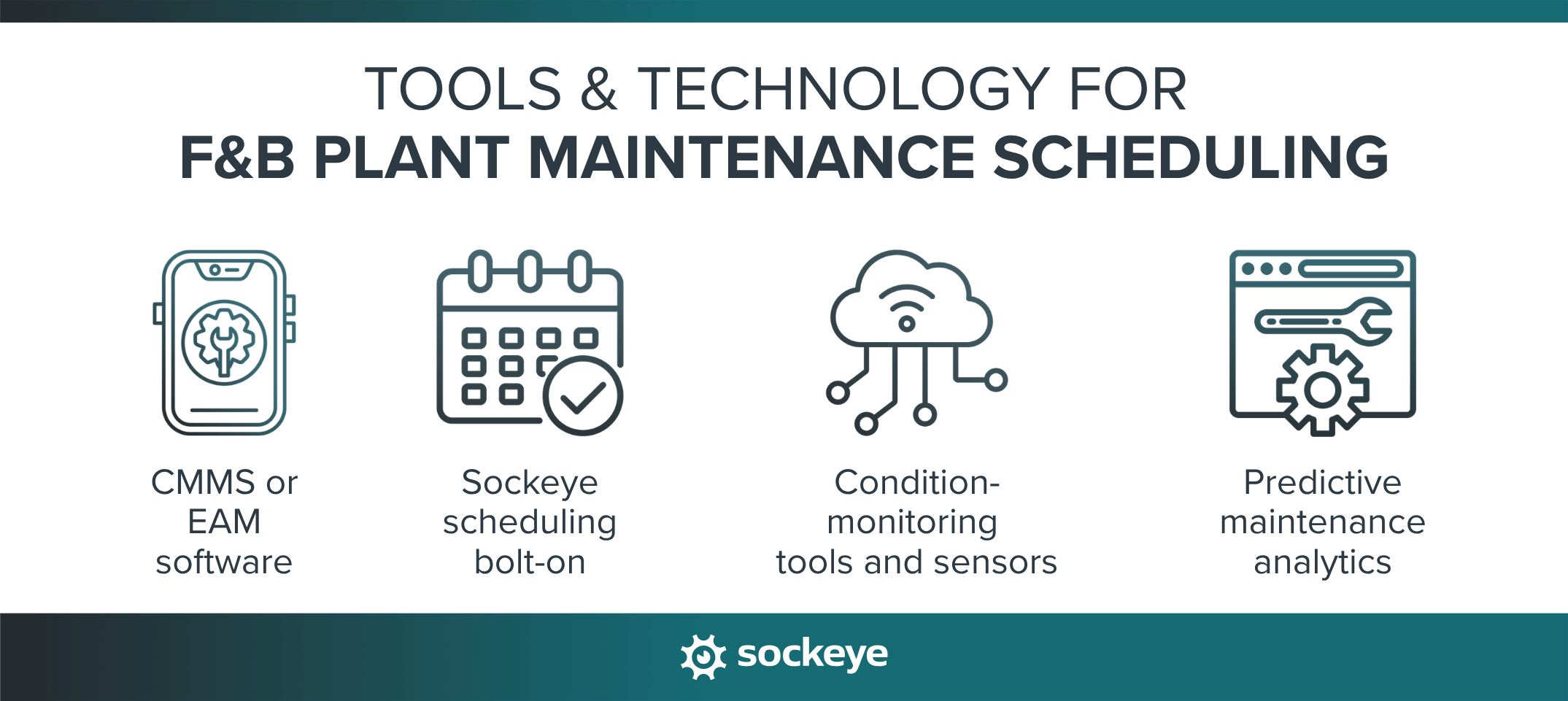
CMMS or EAM software
CMMS solutions (like MaintainX, UpKeep, Limble, Maintenance Connection) and EAM platforms (like IBM Maximo, SAP EAM, JDE, QAD) are the backbone of most maintenance operations. They act as a central hub for managing assets, planning and scheduling work orders, and storing maintenance history — all in one place.
For food and beverage plants, these systems are especially valuable because they bring structure and traceability to maintenance activities, which is critical for both operational efficiency and regulatory compliance.
How they help with maintenance scheduling:
- Centralize all maintenance tasks, schedules, and asset data in one system.
- Automate preventive maintenance based on time, usage, or condition triggers.
- Ensure maintenance activities are logged and easily retrievable for audits.
- Provide visibility into upcoming work, reducing missed or delayed tasks.
- Maintain detailed histories for each asset, supporting better planning and decision-making.
Sockeye scheduling bolt-on
While CMMS and EAM platforms are great for many things, they often fall short when it comes to creating and updating maintenance schedules.
What should be a simple process quickly becomes slow and rigid, with limited visibility and clunky interfaces. As a result, planners and schedulers frequently export data into Excel just to build and adjust schedules in a way that actually works.
That workaround creates its own problems. Spreadsheets become outdated almost instantly, changes aren’t synced back properly, and teams lose their single source of truth.
Sockeye is designed to solve this specific problem. It integrates directly with your CMMS or EAM, so you can handle all scheduling and rescheduling in Sockeye, while everything else — work orders, asset data, history — remains in your core system. The two stay fully synced, so you get flexibility without losing control or data integrity.
How Sockeye simplifies maintenance scheduling for food and beverage plants:
- Automate the maintenance scheduling process and reduce manual scheduling work by up to 90%. Less time spent scheduling means more time to create better job plans.
- Quickly reschedule work using drag-and-drop when priorities change, without breaking dependencies or losing track of tasks.
- Maintain a live, easily shared, up-to-date schedule that syncs automatically with your CMMS/EAM.
- Eliminate reliance on spreadsheets and manual workarounds.
- Increase maintenance schedule compliance by making schedules easier to understand and by creating a more balanced workload between teams and shifts.
- Track why scheduled work gets delayed so you can identify and eliminate root causes of those delays
Condition-monitoring tools and sensors
Condition-monitoring tools and sensors give maintenance teams real-time visibility into how equipment is actually performing. Instead of relying solely on fixed schedules, you can track key parameters — like temperature, vibration, pressure, or humidity — and detect early signs of wear or failure.
How they help with maintenance scheduling:
- Trigger maintenance based on actual equipment condition rather than fixed time or usage intervals.
- Detect early warning signs (e.g., increased vibration in a motor or abnormal temperature in a refrigeration unit).
- Help prioritize work by identifying which assets are most at risk of failure.
- Reduce unnecessary maintenance on healthy equipment, freeing up time and resources.
- Enable better maintenance planning during available production or sanitation windows.
- Support compliance by providing data-backed evidence of equipment monitoring and control.
- Improve coordination by giving teams advance notice of potential issues instead of reacting to breakdowns.
Predictive maintenance analytics
Predictive maintenance takes condition monitoring a step further by using historical data, trends, and machine learning algorithms to forecast when equipment is likely to fail. In food and beverage plants, this is a powerful (although expensive) shift towards reducing risk while improving efficiency.
How predictive maintenance helps with maintenance scheduling:
- Forecast failures in advance, allowing maintenance to be scheduled during planned downtime or sanitation windows.
- Reduce emergency repairs that disrupt existing preventive maintenance schedules.
- Optimize maintenance frequency based on actual asset behavior.
- Improve resource planning by giving teams more lead time to prepare parts, tools, and labor.
- Support compliance with documented, data-driven maintenance scheduling decisions.
The intricacies of food processing equipment maintenance
Unlike other industries, where maintenance can often be scheduled purely around equipment needs, food processing requires careful coordination with cleaning cycles, production schedules, and regulatory requirements. That makes maintenance more constrained, more sensitive, and far less forgiving.
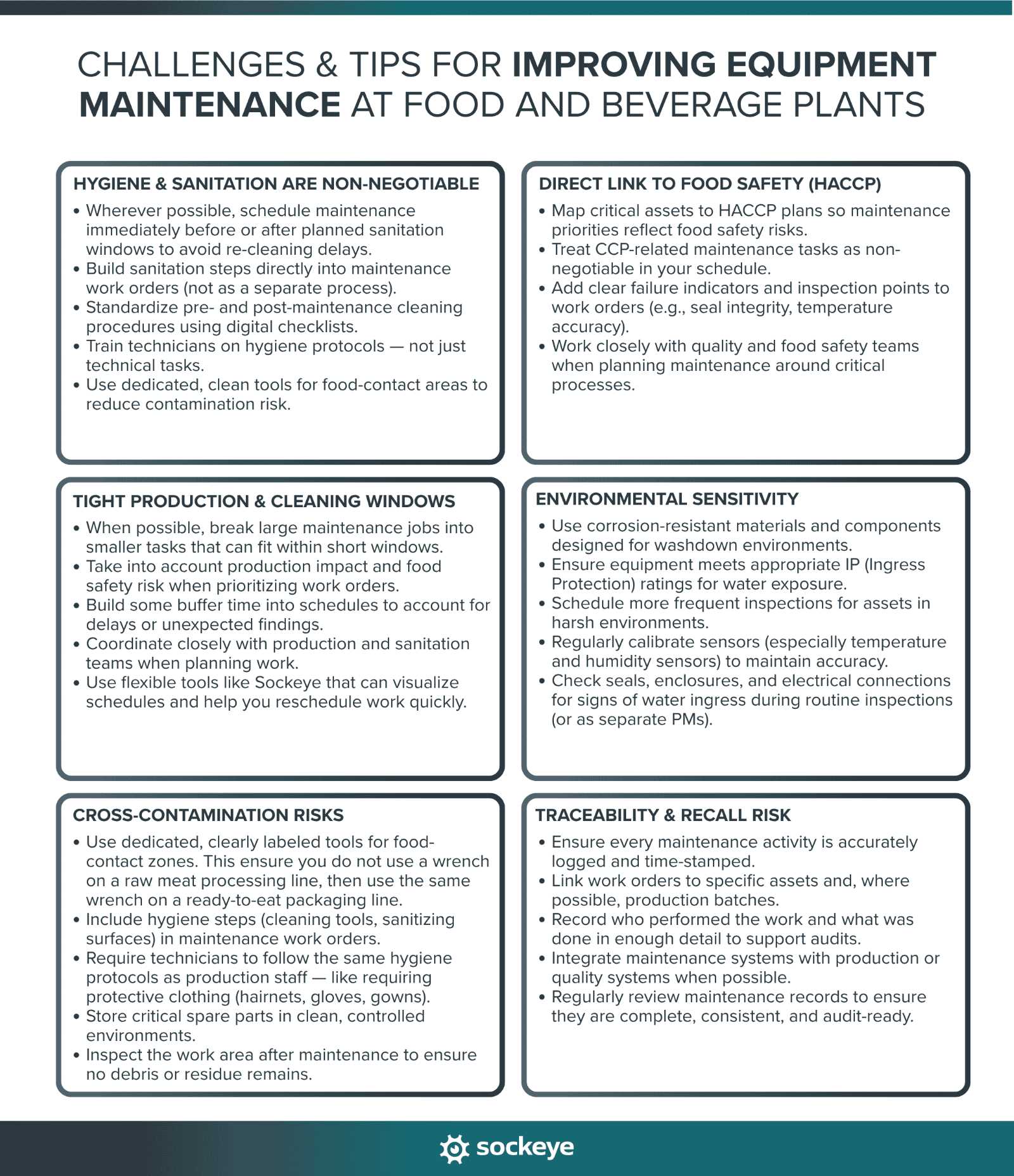
1. Hygiene & sanitation are non-negotiable
In most industries, maintenance focuses on performance. In food processing, cleanliness is equally important.
What makes this especially challenging is the frequency and rigor of cleaning. Equipment often needs to be cleaned daily — or even multiple times per shift — and maintenance work must fit within those sanitation cycles. On top of that, technicians must use food-grade materials, and equipment surfaces must remain easy to clean and resistant to corrosion.
A few scheduling and maintenance tips:
- Wherever possible, schedule maintenance immediately before or after planned sanitation windows to avoid re-cleaning delays.
- Build sanitation steps directly into maintenance work orders (not as a separate process).
- Standardize pre- and post-maintenance cleaning procedures using digital checklists.
- Train technicians on hygiene protocols — not just technical tasks.
- Use dedicated, clean tools for food-contact areas to reduce contamination risk.
Many food plants also rely on systems like Clean-in-Place (CIP) and Clean-out-of-Place (COP) to automate and standardize cleaning. Maintenance teams need to understand how these systems work and ensure they remain fully operational.
2. Direct link to food safety (HACCP)
Frameworks like Hazard Analysis and Critical Control Points (HACCP) explicitly tie equipment condition and maintenance activities to risk control.
That means equipment failures aren’t just operational issues — they can directly introduce biological, chemical, or physical hazards into your products. Because of this, many maintenance tasks are linked to Critical Control Points (CCPs), where failure to act can compromise food safety.
Real-world examples:
- A worn or broken seal can allow bacteria to enter a processing line.
- Metal wear in a mixer or conveyor can introduce foreign objects into food.
- A refrigeration failure can push products outside safe temperature ranges.
- A faulty valve can lead to improper cleaning or chemical residue.
A few scheduling and maintenance tips:
- Map critical assets to HACCP plans so maintenance priorities reflect food safety risks.
- Treat CCP-related maintenance tasks as non-negotiable in your schedule.
- Add clear failure indicators and inspection points to work orders (e.g., seal integrity, temperature accuracy).
- Work closely with quality and food safety teams when planning maintenance around critical processes.
3. Hygienic equipment design constraints
Food processing equipment isn’t designed the same way as typical industrial machinery. Every detail — from the shape of surfaces to how components are joined — is built to minimize contamination risk and make cleaning easier.
Maintenance teams need to ensure they are not replacing parts with non-compliant alternatives or reassemble machines in a way that makes is hard (or impossible) to clean properly.
A few maintenance tips:
- Always use OEM or food-grade approved replacement parts — avoid “close enough” substitutes.
- Inspect welds, seals, and joints after maintenance to ensure they meet hygienic standards.
- Train technicians to recognize hygienic design principles, not just mechanical fit.
- Document any modifications to equipment and validate that they don’t impact cleanability.
- Involve quality or food safety teams when making structural repairs or changes.
4. Tight production & cleaning windows
In F&B plants, most maintenance work has to fit into narrow windows: between shifts, during planned sanitation cycles, or overnight. If a task runs over, it doesn’t just affect the maintenance schedule — it can delay cleaning, disrupt production start times, and even lead to product spoilage.
Since there’s little room for error or overruns, maintenance tasks must be tightly planned and realistically estimated.
A few scheduling and maintenance tips:
- When possible, break large maintenance jobs into smaller tasks that can fit within short windows.
- Take into account production impact and food safety risk when prioritizing work orders.
- Build some buffer time into schedules to account for delays or unexpected findings.
- Coordinate closely with production and sanitation teams when planning work.
- Use flexible tools like Sockeye that can visualize schedules and help you reschedule work quickly.
5. Environmental sensitivity
From cold storage and freezers to high-humidity washdown areas, your equipment is constantly exposed to temperature swings, water, and aggressive cleaning chemicals.
These conditions accelerate wear and tear, affect sensor accuracy, and increase the risk of corrosion or electrical failure. As a result, maintenance scheduling needs to account for the environment — not just the equipment itself.
A few scheduling and maintenance tips:
- Use corrosion-resistant materials and components designed for washdown environments.
- Ensure equipment meets appropriate IP (Ingress Protection) ratings for water exposure.
- Schedule more frequent inspections for assets in harsh environments.
- Regularly calibrate sensors (especially temperature and humidity sensors) to maintain accuracy.
- Check seals, enclosures, and electrical connections for signs of water ingress during routine inspections (or as separate PMs).
6. Cross-contamination risks
Maintenance activities themselves can become a source of contamination if not handled carefully. Unlike other industries, where tools and parts just need to be functional, food and beverage environments require everything that comes into contact with equipment to meet strict hygiene standards.
A few maintenance tips:
- Use dedicated, clearly labeled tools for food-contact zones. This ensure you do not use a wrench on a raw meat processing line, then use the same wrench on a ready-to-eat packaging line.
- Include hygiene steps (cleaning tools, sanitizing surfaces) in maintenance work orders.
- Require technicians to follow the same hygiene protocols as production staff — like requiring protective clothing (hairnets, gloves, gowns).
- Store critical spare parts in clean, controlled environments.
- Inspect the work area after maintenance to ensure no debris or residue remains.
7. Traceability & recall risk
If something goes wrong, you need to quickly trace what happened, when it happened, and which equipment may have been involved.
So, it’s not enough to know that a machine was repaired — you need to know which batches were processed before and after, who performed the work, and whether the issue could have impacted product safety.
A few maintenance tips:
- Ensure every maintenance activity is accurately logged and time-stamped.
- Link work orders to specific assets and, where possible, production batches.
- Record who performed the work and what was done in enough detail to support audits.
- Integrate maintenance systems with production or quality systems when possible.
- Regularly review maintenance records to ensure they are complete, consistent, and audit-ready.
Streamline scheduling for F&B plants with Sockeye
As we’ve seen throughout this guide, food plant maintenance scheduling is uniquely complex. Trying to manage it with spreadsheets or legacy maintenance software quickly becomes inefficient and error-prone.
Don’t waste time trying to build an in-house solution or searching for different asset management software. Just outsource scheduling to Sockeye.
Here’s how it works:
By simplifying how schedules are created and adjusted, Sockeye helps maintenance teams spend less time managing schedules — and more time preparing and executing plans effectively.
If scheduling is slowing your team down, it’s worth seeing how a purpose-built tool can make a difference.
👉 Schedule a demo with the Sockeye team to learn more.
